
Engine room fires keep starting the same way: fuel spray on hot surfaces
20 November 2026 · 6 min read · EyeCU team
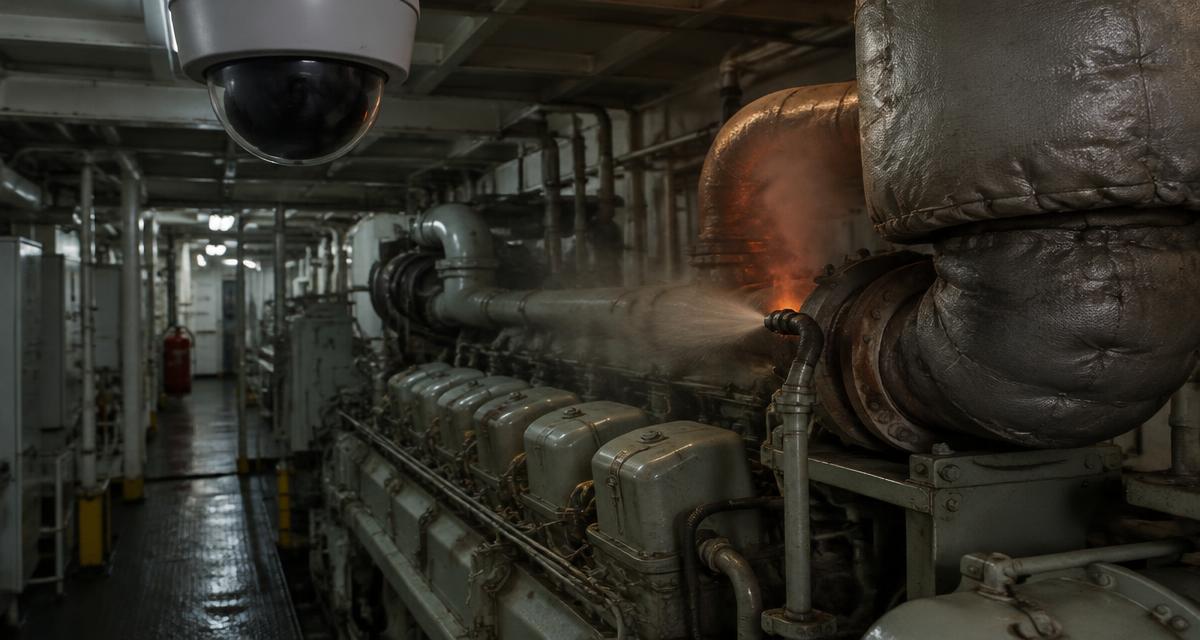
Illustration, not a photo of the incidents described.
Three recent official investigations — Stena Europe, Finnmaster and Scot Stuttgart — show leaked fuel meeting hot surfaces. What the reports say, and where camera monitoring can add awareness.
One pattern, three ships
Official accident investigators keep publishing engine room fire reports with a familiar root cause: fuel escapes from a pipe, hose or open line and reaches a surface hot enough to ignite it.
On ro-ro passenger ferry Stena Europe (February 2023), the UK Marine Accident Investigation Branch (MAIB) found that pressurised fuel from a loose fuel pipe connection sprayed onto a high-temperature exhaust pipe. Neither the spray shielding nor the hot-surface insulation was effective.
On ro-ro cargo ship Finnmaster (September 2021, report published September 2025), MAIB found that mechanical failures on an auxiliary engine let fuel leak from a flexible hose onto a hot surface. The hose had been fitted in an unapproved modification, the emergency generator could not supply emergency systems, and the fixed CO₂ system did not fully operate.
On chemical tanker Scot Stuttgart (May 2025), the US National Transportation Safety Board (NTSB) found that a fuel return line was not isolated during maintenance, so diesel backflowed from a day tank onto an electrical panel or exhaust gas economizer lines, where it ignited.
What the investigators recommend
The reports focus on prevention and response, not technology for its own sake:
- Inspect fuel pipe connections and fit manufacturer-recommended modifications (Stena Europe).
- Find exposed hot surfaces properly: MAIB recommended the MCA propose to IMO a requirement for thermographic equipment, after the crew's temperature tools missed hot spots (Stena Europe).
- Use only approved components and test emergency power and fixed firefighting systems (Finnmaster).
- Consult vessel drawings when isolating fuel, lube or hydraulic systems for maintenance (Scot Stuttgart).
- Keep the space sealed after releasing a fixed gas system; ventilating early reduced the CO₂ concentration and let the fire burn longer (Scot Stuttgart).
Where camera-based monitoring fits
None of these reports says cameras would have prevented the fire, and we do not claim that. Fire detection and fixed extinguishing systems required under SOLAS remain the primary safeguards.
What continuous visual monitoring can add is another layer of awareness in spaces that are often unattended: a camera can show visible fuel mist, a spreading wet patch, early smoke or a flame, and send the image to the watchkeeper so they can look before deciding what to do. Paired with radiometric thermal cameras, it can also track surface temperatures over time — the gap MAIB identified on Stena Europe.
Visual systems have limits. They cannot see inside lagging, measure fuel pressure or detect vapour that is not visible, and they must be tuned to ignore steam, welding and reflections. EyeCU is designed as a supplement to certified alarms, with a human confirming every alert.
Practical takeaways for superintendents
- Review hot-surface insulation and spray shields near every fuel pipe connection on main and auxiliary engines.
- Add thermographic surveys to planned maintenance, and act on the readings.
- Check that every flexible fuel hose is approved for its service.
- Include system isolation and drawing checks in permit-to-work for fuel system maintenance.
- Drill the decision to keep a space sealed after a CO₂ release, including with shore firefighters.