
Edge AI ship safety in UAE waters: turning existing CCTV into early warning
24 November 2026 · 7 min read · EyeCU team
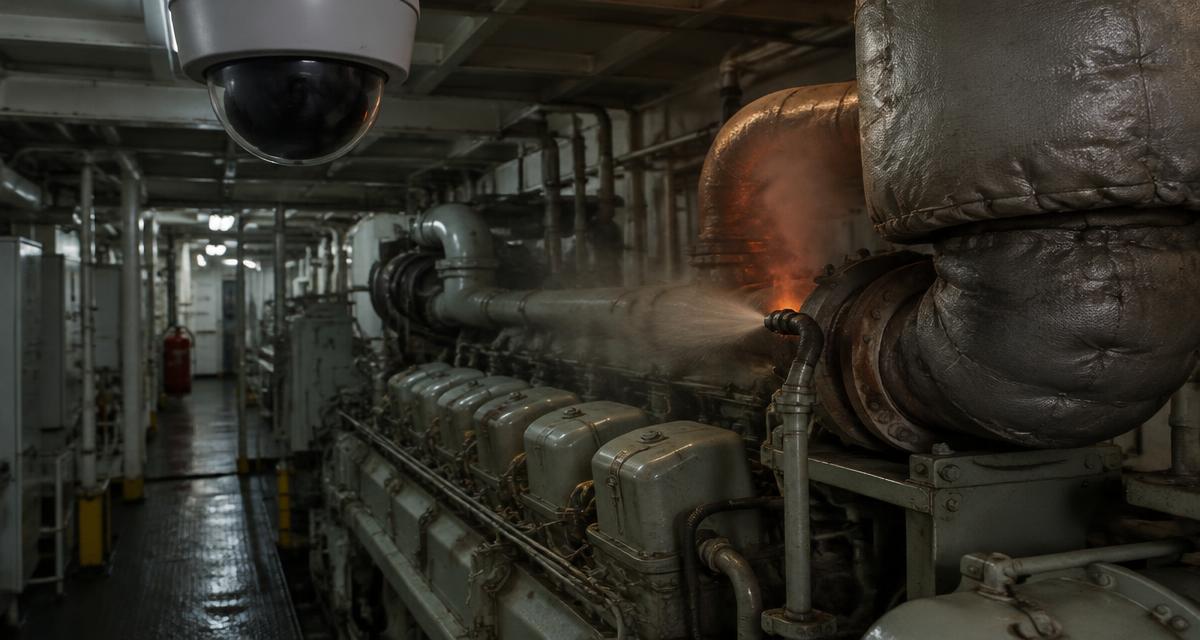
Illustration, not a photo of the incidents described.
How onboard edge AI can turn a vessel's existing CCTV into advisory alerts for early smoke, flame, PPE and restricted-zone risks across UAE tanker, OSV and port operations — without streaming video ashore.
Operating conditions in the Gulf
Vessels trading in the Arabian Gulf and Gulf of Oman face high seawater and ambient temperatures. Summer engine room temperatures well above 40°C add thermal stress to auxiliary machinery, boiler lines and fuel systems.
Busy operating areas — bunkering off Fujairah, container terminals at Jebel Ali, and offshore support hubs in Abu Dhabi and Ras Al Khaimah — need constant vigilance. Most ships already carry CCTV, but it usually records to a drive and is reviewed only after an incident.
Onboard edge AI turns those passive streams into an active, advisory layer that prompts the watchkeeper to look.
Why engine room fires still catch crews out
Casualty investigations repeatedly describe the same sequence:
- Pressurised fuel, lube or thermal oil escapes from a loose fitting, damaged pipe or unapproved flexible hose.
- The spray reaches an exhaust or other surface that is hot enough to ignite it.
- Ignition can happen before ceiling-mounted smoke or heat detectors respond, because they need smoke or heat to reach them.
Why the analysis should run on the ship
Streaming multi-camera video over VSAT or LEO satellite links is costly and stops working when the link drops. Continuous upload of crew video also raises welfare and privacy concerns under MLC 2006.
EyeCU is designed to analyse video on an industrial edge appliance connected to the ship's CCTV network. Video stays on board; only compact alerts, evidence snapshots and audit records sync to shore when a link is available, and local alerts continue during outages.
Three capabilities for UAE fleets
- Early smoke and flame cues: checks flame flicker, plume growth and background haze to separate likely smoke or flame from lamps, glare and reflective metal, with every alert confirmed by a person.
- Engine room ambient baseline: heat thresholds are set relative to a voyage baseline officers can adjust for Gulf summer conditions, using radiometric thermal readings where fitted.
- PPE and restricted zones: counts people in required PPE on decks and in workshops, and flags entry into areas marked no-entry while underway. Faces are blurred in saved evidence when privacy is enabled.
- Time-to-ACK: measures how quickly watchkeepers acknowledge fire, smoke and heat alerts, giving DPAs and superintendents a verifiable response metric.
An advisory layer, not a replacement
Camera-based AI is decision support. It does not replace SOLAS Chapter II-2 fixed fire detection or any type-approved alarm equipment, and it never silences or resets certified panels. Its purpose is to give the crew extra time to investigate a possible fuel spray, smouldering lagging or unsafe entry.
Detection performance depends on camera placement, lighting and site commissioning, and must be validated on each vessel.
Checklist for superintendents and DPAs
- Audit CCTV coverage of auxiliary engine fuel rails, purifiers, bunker manifolds and mooring decks.
- Review hot-surface insulation and spray shielding near fuel connections.
- Set engine room ambient baselines for seasonal Gulf trading.
- Insist that any AI runs on the ship's own network rather than depending on satellite streaming.
Regional support in the UAE
EyeCU is supported in the UAE from our regional office in the Ras Al Khaimah Economic Zone (RAKEZ), working with ship managers, offshore operators and terminals in Dubai, Abu Dhabi, Fujairah and Ras Al Khaimah.